• Trade
  • Markets
  • Copy
  • Contests
  • News
  • 24/7
  • Calendar
  • Q&A
  • Chats
Trending
Screeners
SYMBOL
LAST
BID
ASK
HIGH
LOW
NET CHG.
%CHG.
SPREAD
SPX
S&P 500 Index
6857.13
6857.13
6857.13
6865.94
6827.13
+7.41
+ 0.11%
--
DJI
Dow Jones Industrial Average
47850.93
47850.93
47850.93
48049.72
47692.96
-31.96
-0.07%
--
IXIC
NASDAQ Composite Index
23505.13
23505.13
23505.13
23528.53
23372.33
+51.04
+ 0.22%
--
USDX
US Dollar Index
98.830
98.910
98.830
98.980
98.830
-0.150
-0.15%
--
EURUSD
Euro / US Dollar
1.16584
1.16591
1.16584
1.16593
1.16408
+0.00139
+ 0.12%
--
GBPUSD
Pound Sterling / US Dollar
1.33485
1.33495
1.33485
1.33495
1.33165
+0.00214
+ 0.16%
--
XAUUSD
Gold / US Dollar
4226.58
4227.01
4226.58
4229.22
4194.54
+19.41
+ 0.46%
--
WTI
Light Sweet Crude Oil
59.298
59.335
59.298
59.469
59.187
-0.085
-0.14%
--

Community Accounts

Signal Accounts
--
Profit Accounts
--
Loss Accounts
--
View More

Become a signal provider

Sell trading signals to earn additional income

View More

Guide to Copy Trading

Get started with ease and confidence

View More

Signal Accounts for Members

All Signal Accounts

Best Return
  • Best Return
  • Best P/L
  • Best MDD
Past 1W
  • Past 1W
  • Past 1M
  • Past 1Y

All Contests

  • All
  • Trump Updates
  • Recommend
  • Stocks
  • Cryptocurrencies
  • Central Banks
  • Featured News
Top News Only
Share

Reserve Bank Of India Chief Malhotra On Rupee: Fluctuations Can Happen, Effort Is To Reduce Undue Volatility

Share

Reserve Bank Of India Chief Malhotra On Rupee: Allow Markets To Determine Levels On Currency

Share

Sri Lanka's CSE All Share Index Down 1.2%

Share

Iw Institute: German Economy Faces Tepid Growth In 2026 Due To Global Trade Slowdown

Share

Stats Office - Seychelles November Inflation At 0.02% Year-On-Year

Share

[Market Update] Spot Silver Prices Rose 2.00% Intraday, Currently Trading At $58.27 Per Ounce

Share

S.Africa's Gross Reserves At $72.068 Billion At End November - Central Bank

Share

[Market Update] Spot Silver Broke Through $58/ounce, Up 1.56% On The Day

Share

Dollar/Yen Down 0.33% To 154.61

Share

Kremlin Says No Plans For Putin-Trump Call For Now

Share

Kremlin Says Moscow Is Waiting For USA Reaction After Putin-Witkoff Meeting

Share

Cctv - China, France: Say Both Sides Support All Efforts For A Ceasefire, Restore Peace According To Intl Law

Share

[Chinese Ambassador To The US Xie Feng Hopes Chinese And American Business Communities Will Focus On Three Lists] On December 4, Chinese Ambassador To The US Xie Feng Delivered A Speech At The China-US Economic And Trade Cooperation Forum Jointly Hosted By The China Council For The Promotion Of International Trade And The Meridian International Center. Xie Feng Said That In November 2026, China Will Host The APEC Leaders' Informal Meeting For The Third Time In Shenzhen, Guangdong Province. In December 2026, The United States Will Also Host The G20 Meeting. Regarding How Chinese And American Business Communities Can Seize These Opportunities, He Suggested Focusing On Three Lists: First, Continue To Expand The Dialogue List; Second, Continuously Lengthen The Cooperation List; And Third, Constantly Reduce The Problem List

Share

India's Nifty Financial Services Index Extends Gains, Last Up 0.75%

Share

Eni : Jp Morgan Cuts To Underweight From Overweight

Share

Cctv - China, France: Signed Protocol On Sanitary, Phytosanitary Requirements For Export Of French Alfalfa Grass

Share

India's NIFTY IT Index Last Up 1.3%

Share

India's Nifty 50 Index Rises 0.35%

Share

Israel Sets 2026 Defence Budget At $34 Billion

Share

Russia Says Azov Sea's Port Of Temryuk Damaged In Ukrainian Attack

TIME
ACT
FCST
PREV
Turkey Trade Balance

A:--

F: --

P: --

Germany Construction PMI (SA) (Nov)

A:--

F: --

P: --

Euro Zone IHS Markit Construction PMI (Nov)

A:--

F: --

P: --

Italy IHS Markit Construction PMI (Nov)

A:--

F: --

P: --

U.K. Markit/CIPS Construction PMI (Nov)

A:--

F: --

P: --

France 10-Year OAT Auction Avg. Yield

A:--

F: --

P: --

Euro Zone Retail Sales MoM (Oct)

A:--

F: --

P: --

Euro Zone Retail Sales YoY (Oct)

A:--

F: --

P: --

Brazil GDP YoY (Q3)

A:--

F: --

P: --

U.S. Challenger Job Cuts (Nov)

A:--

F: --

P: --

U.S. Challenger Job Cuts MoM (Nov)

A:--

F: --

P: --

U.S. Challenger Job Cuts YoY (Nov)

A:--

F: --

P: --

U.S. Initial Jobless Claims 4-Week Avg. (SA)

A:--

F: --

P: --

U.S. Weekly Initial Jobless Claims (SA)

A:--

F: --

P: --

U.S. Weekly Continued Jobless Claims (SA)

A:--

F: --

P: --

Canada Ivey PMI (SA) (Nov)

A:--

F: --

P: --

Canada Ivey PMI (Not SA) (Nov)

A:--

F: --

P: --

U.S. Non-Defense Capital Durable Goods Orders Revised MoM (Excl. Aircraft) (SA) (Sept)

A:--

F: --

P: --
U.S. Factory Orders MoM (Excl. Transport) (Sept)

A:--

F: --

P: --

U.S. Factory Orders MoM (Sept)

A:--

F: --

P: --

U.S. Factory Orders MoM (Excl. Defense) (Sept)

A:--

F: --

P: --

U.S. EIA Weekly Natural Gas Stocks Change

A:--

F: --

P: --

Saudi Arabia Crude Oil Production

A:--

F: --

P: --

U.S. Weekly Treasuries Held by Foreign Central Banks

A:--

F: --

P: --

Japan Foreign Exchange Reserves (Nov)

A:--

F: --

P: --

India Repo Rate

A:--

F: --

P: --

India Benchmark Interest Rate

A:--

F: --

P: --

India Reverse Repo Rate

A:--

F: --

P: --

India Cash Reserve Ratio

A:--

F: --

P: --

Japan Leading Indicators Prelim (Oct)

A:--

F: --

P: --

U.K. Halifax House Price Index YoY (SA) (Nov)

--

F: --

P: --

U.K. Halifax House Price Index MoM (SA) (Nov)

--

F: --

P: --

France Current Account (Not SA) (Oct)

--

F: --

P: --

France Trade Balance (SA) (Oct)

--

F: --

P: --

France Industrial Output MoM (SA) (Oct)

--

F: --

P: --

Italy Retail Sales MoM (SA) (Oct)

--

F: --

P: --

Euro Zone Employment YoY (SA) (Q3)

--

F: --

P: --

Euro Zone GDP Final YoY (Q3)

--

F: --

P: --

Euro Zone GDP Final QoQ (Q3)

--

F: --

P: --

Euro Zone Employment Final QoQ (SA) (Q3)

--

F: --

P: --

Euro Zone Employment Final (SA) (Q3)

--

F: --

P: --
Brazil PPI MoM (Oct)

--

F: --

P: --

Mexico Consumer Confidence Index (Nov)

--

F: --

P: --

Canada Unemployment Rate (SA) (Nov)

--

F: --

P: --

Canada Labor Force Participation Rate (SA) (Nov)

--

F: --

P: --

Canada Employment (SA) (Nov)

--

F: --

P: --

Canada Part-Time Employment (SA) (Nov)

--

F: --

P: --

Canada Full-time Employment (SA) (Nov)

--

F: --

P: --

U.S. Dallas Fed PCE Price Index YoY (Sept)

--

F: --

P: --

U.S. PCE Price Index YoY (SA) (Sept)

--

F: --

P: --

U.S. PCE Price Index MoM (Sept)

--

F: --

P: --

U.S. Personal Outlays MoM (SA) (Sept)

--

F: --

P: --

U.S. Core PCE Price Index MoM (Sept)

--

F: --

P: --

U.S. UMich 5-Year-Ahead Inflation Expectations Prelim YoY (Dec)

--

F: --

P: --

U.S. Core PCE Price Index YoY (Sept)

--

F: --

P: --

U.S. 5-10 Year-Ahead Inflation Expectations (Dec)

--

F: --

P: --

U.S. UMich Current Economic Conditions Index Prelim (Dec)

--

F: --

P: --

U.S. UMich Consumer Sentiment Index Prelim (Dec)

--

F: --

P: --

U.S. UMich 1-Year-Ahead Inflation Expectations Prelim (Dec)

--

F: --

P: --

U.S. UMich Consumer Expectations Index Prelim (Dec)

--

F: --

P: --

Q&A with Experts
    • All
    • Chatrooms
    • Groups
    • Friends
    Connecting
    .
    .
    .
    Type here...
    Add Symbol or Code

      No matching data

      All
      Trump Updates
      Recommend
      Stocks
      Cryptocurrencies
      Central Banks
      Featured News
      • All
      • Russia-Ukraine Conflict
      • Middle East Flashpoint
      • All
      • Russia-Ukraine Conflict
      • Middle East Flashpoint
      Search
      Products

      Charts Free Forever

      Chats Q&A with Experts
      Screeners Economic Calendar Data Tools
      Membership Features
      Data Warehouse Market Trends Institutional Data Policy Rates Macro

      Market Trends

      Market Sentiment Order Book Forex Correlations

      Top Indicators

      Charts Free Forever
      Markets

      News

      News Analysis 24/7 Columns Education
      From Institutions From Analysts
      Topics Columnists

      Latest Views

      Latest Views

      Trending Topics

      Top Columnists

      Latest Update

      Signals

      Copy Rankings Latest Signals Become a signal provider AI Rating
      Contests
      Brokers

      Overview Brokers Assessment Rankings Regulators News Claims
      Broker listing Forex Brokers Comparison Tool Live Spread Comparison Scam
      Q&A Complaint Scam Alert Videos Tips to Detect Scam
      More

      Business
      Events
      Careers About Us Advertising Help Center

      White Label

      Data API

      Web Plug-ins

      Affiliate Program

      Awards Institution Evaluation IB Seminar Salon Event Exhibition
      Vietnam Thailand Singapore Dubai
      Fans Party Investment Sharing Session
      FastBull Summit BrokersView Expo
      Recent Searches
        Top Searches
          Markets
          News
          Analysis
          User
          24/7
          Economic Calendar
          Education
          Data
          • Names
          • Latest
          • Prev

          View All

          No data

          Scan to Download

          Faster Charts, Chat Faster!

          Download App
          English
          • English
          • Español
          • العربية
          • Bahasa Indonesia
          • Bahasa Melayu
          • Tiếng Việt
          • ภาษาไทย
          • Français
          • Italiano
          • Türkçe
          • Русский язык
          • 简中
          • 繁中
          Open Account
          Search
          Products
          Charts Free Forever
          Markets
          News
          Signals

          Copy Rankings Latest Signals Become a signal provider AI Rating
          Contests
          Brokers

          Overview Brokers Assessment Rankings Regulators News Claims
          Broker listing Forex Brokers Comparison Tool Live Spread Comparison Scam
          Q&A Complaint Scam Alert Videos Tips to Detect Scam
          More

          Business
          Events
          Careers About Us Advertising Help Center

          White Label

          Data API

          Web Plug-ins

          Affiliate Program

          Awards Institution Evaluation IB Seminar Salon Event Exhibition
          Vietnam Thailand Singapore Dubai
          Fans Party Investment Sharing Session
          FastBull Summit BrokersView Expo

          Will the Fed's Rate Hikes Cause U.S. Stocks to Crash?

          Eva Chen

          Central Bank

          Summary:

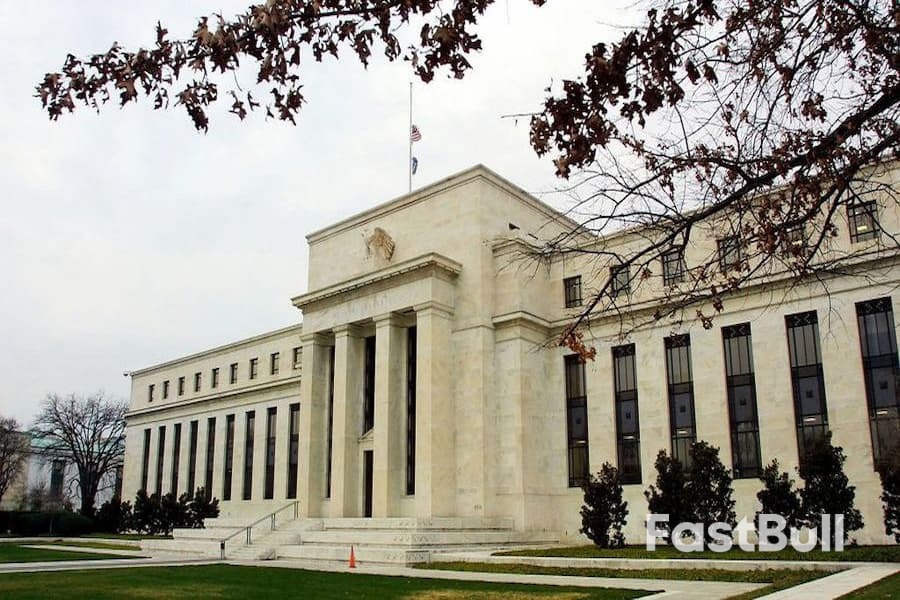
          The current inflation in the US is very high. According to the latest data released by the US Department of Labor, the US CPI consumer price index in February was 7.9%, a new high since 1982. Against this backdrop, many are starting to predict whether the Fed will raise rates more aggressively than expected. At the same time, there are also concerns that the Fed's rate hike may cause the stock market to crash. The internal logic of the Fed raising interest rates is not so simple. The Fed raising interest rates will not definetely cause the stock market to crash.
          Will the Fed's Rate Hikes Cause U.S. Stocks to Crash?_1

          Fed Rate Hike Won't Directly Cause US Stocks to Crash

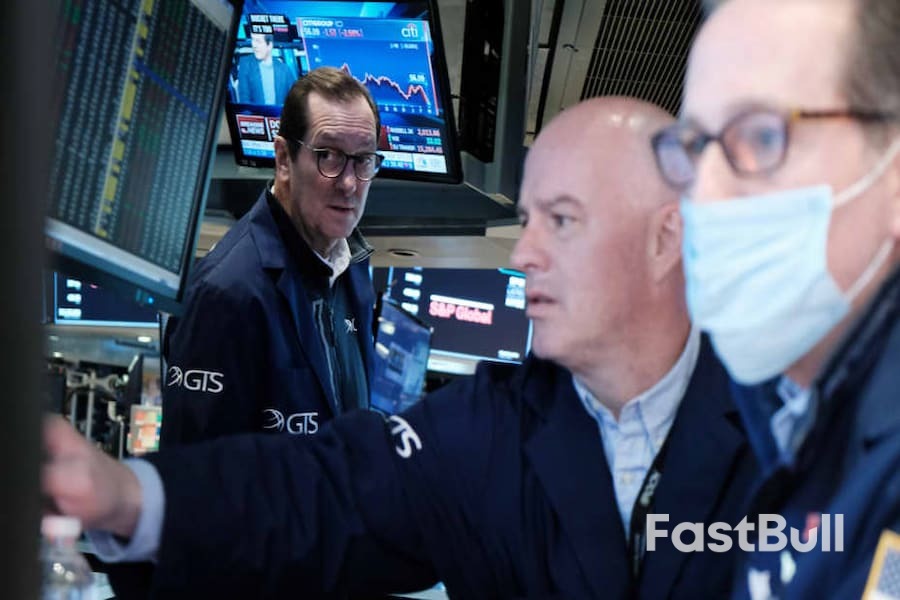
          Let's look at the data first. Reuters believes that starting in March, the Fed's rate hike will be a big bang. Citibank expects four rate hikes this year, Societe Generale expects five rate hikes this year starting in March, and Goldman Sachs expects seven rate hikes this year. The basis points of rate hikes expected by investment banks are roughly around 150 basis points. So, can the market withstand such a strong rate hike, or will it lead to a full-blown financial-market crash? The Wall Street Journal also used this kind of title that "The Fed Missed Inflation. Can Jay Powell Tame It Without Causing a Recession?".
          This question is also raised on a realistic basis because the performance of US stocks during this period is not very well. On the one hand, it is because the US is worried about rising interest rates in the market, and on the other hand, the military conflict between Russia and Ukraine has caused widespread concern in the market. In other words, the entire market is currently worried about high inflation. In this context, it is practical to discuss the impact of the Fed's rate hike on the market.
          From the end of World War II to the end of 2021, the Fed has experienced a total of 13 rate hike cycles, with an average rate hike cycle of about 25 months per round. From the 1990s to the present, there have been five rate hike cycles, of which the stock market has risen in four of the rate hike cycles.
          From 2015, when the Fed announced the end of quantitative easing, it began to raise interest rates until it was forced to suspend rate hikes in 2019, and the stock market rose dramatically. Nasdaq tech stocks, in particular, have risen more than 400% in a decade. In the previous rate hikes since the 1990s, the S&P 500 index has never shown a downward trend but has risen more, so rate hikes and rate cuts do not necessarily represent the rise or fall of the stock market.
          Will the Fed's Rate Hikes Cause U.S. Stocks to Crash?_2

          Investment Market & Arbitrage

          Let's come back to the previous question now. Will the Fed's rate hikes cause the stock market to crash? The stock market is a high-risk investment market, and the Fed's rate (interest rate) hike does not directly affect the investment market. The Fed's rate hike affects low-risk arbitrage. A lot of people get this logic backward. The core of capital is money. Money exists in various forms. For example, stocks and real estate are both forms of money. But in fact, the core of capital is credit and loans, not money on the surface. Credit is directly affected by risks and interest rates. The rise and fall of the investment market that we see on the surface are driven by changes in credit, that is, changes in risk-free arbitrage, so arbitrage affects the investment market.
          Since the turn of the century, interest rates have been falling, and the supply of money has been increasing. At the same time, the US outsourcing of physical business has also caused an economic downturn. Under the background that the overall pattern has not changed, the overall interest rate has been in a downward trend, and eventually near-zero interest rates. The broad money supply has risen rapidly, exceeding 21.8 trillion USD, indicating that low-interest rates bring high debt; the more money is borrowed, the more broad money will be generated. But in such a low-interest-rate environment, have both money and debt entered the investment field? The answer is no. Especially since 2002, the debt has continued to increase and the interest rate has continued to decrease; however, a large number of currencies have entered the high-risk securities investment industry, but have not entered the physical investment.
          According to the statistics of Bank of America, the total amount of funds flowing into the securities market in 2021 has exceeded the total of the past 19 years, reaching 900 billion USD; and since 2022, global securities funds have also seen a large number of capital inflows in February, reaching $24 billion in its first week. It can be seen that even though the market is still worried about the Fed raising interest rates, the currency continues to flow into the high-risk financial speculative market. The currency is not used for investment in the real economy but continues to flow into the high-risk speculative market. It will invisibly push up the potential risks of the overall market.
          A rise in short-term uncertainty can push up short-term interest rates as well. While we have seen all major stock indices around the world rise significantly in the wake of the pandemic, it does not mask a general rise in risk. In the past two years, this kind of risk has not fully erupted because the central banks around the world have carried out large-scale quantitative easing, temporarily reducing the risk artificially; cheap credit and cheap money have forcibly distorted the risk index and interest rate cycle, and caused a temporary reduction in risk.
          In other words, when the central bank system is no longer providing a lot of cheap credit and cheap money, the market risk index and real interest will return to the way they were. So now the Fed’s rate hikes mark that the market risk has changed from the previous distorted state to a normalized high-risk state. But once it returns to normal, it will invisibly raise short-term interest rates in the market, resulting in a narrowing of short-term interest rate spreads, or even a reversal, which will have a significant impact on arbitrage. That is the core part of the problem.
          Will the Fed's Rate Hikes Cause U.S. Stocks to Crash?_3

          How Financial Markets are Manipulated

          We know that banks are the main institutions that provide credit to enterprises, and the basic profit model of banks is arbitrage. The specific situation is to use borrow short and lend long to arbitrage. The reason why to borrow short-term deposits and lend them for long-term investent is that under normal circumstances, the short-term risk is lower than the long-term risk, so the short-term interest is lower than the long-term interest; the longer the time is, the higher the uncertainty will be. For example, banks borrow capitals at the short-term interest rate of 1% and lend them to the enterprises at the long-term interest rate of 3% , so the banks have sufficient arbitrage space; the banks are only willing to lend if it is sure to make money, and the enterprises can expand its business after obtaining the loan.
          However, the problem is that the current rapid changes in the market will cause short-term risks to rise rapidly, so short-term interest rates will rise rapidly. In the previous example, the interest rate of the bank borrowing money is no longer 1%, but will rise to 2%, or even close to 3%, and then the room for bank arbitrage will be narrower and narrower; at this time, the bank will lend less, so businesses can't get loans. Thus the economy will slow down, and a crisis will follow.
          So why does the Fed take the initiative to raise interest rates to increase market risks? The Fed is not a savior of the market, nor does he save the market by normalizing interest rates. The role of the Fed is to adjust the regulator of the interest rate switch. The big man behind the regulator is the real oligarch in the US; Every time the switch of this regulator is turned on or off, it heralds the beginning of a new harvest.
          On the surface, it seems that the Fed is making adjustments to normalize interest rates, but in fact, it is adjusting the rhythm of the market cycle back and forth to serve the interests of the top capital groups. The so-called market is nothing but the casinos and ATMs where they sit in the bank. The current pattern will not fundamentally change for a long period in the future.
          Because the investment and expansion of industries is the basis for the existence of the capital market, the basis of credit investment in industries is the existence of arbitrage space, and the premise of the existence of arbitrage space is that market risks present a natural and reasonable distribution, allowing financial institutions to borrow short-term deposites and lend them for long-term investment; But the current global market is a market where risks are distorted and manipulated, so there is no real arbitrage space. In other words, the reinvestment of industry is not real. It is just an accessory manipulated by the so-called financial casino power.
          Risk Warnings and Disclaimers
          You understand and acknowledge that there is a high degree of risk involved in trading. Following any strategies or investment methods may lead to potential losses. The content on the site is provided by our contributors and analysts for information purposes only. You are solely responsible for determining whether any trading assets, securities, strategy, or any other product is suitable for investing based on your own investment objectives and financial situation.
          Comments
          Add to Favorites
          Share

          What's Happening in the Forex Market?

          Olatunji Tolu
          Good morning All,
          How are you doing today?
          Happy new week
          No significant GAPs in the market as expected but volatility is still high across board as a result of the on-going war in Ukraine.
          Ukraine's President, Zelensky has stated that he will continue to negotiate with Russia and according to the US White House, there's fear of possible chemical weapons on the cards for Russia.
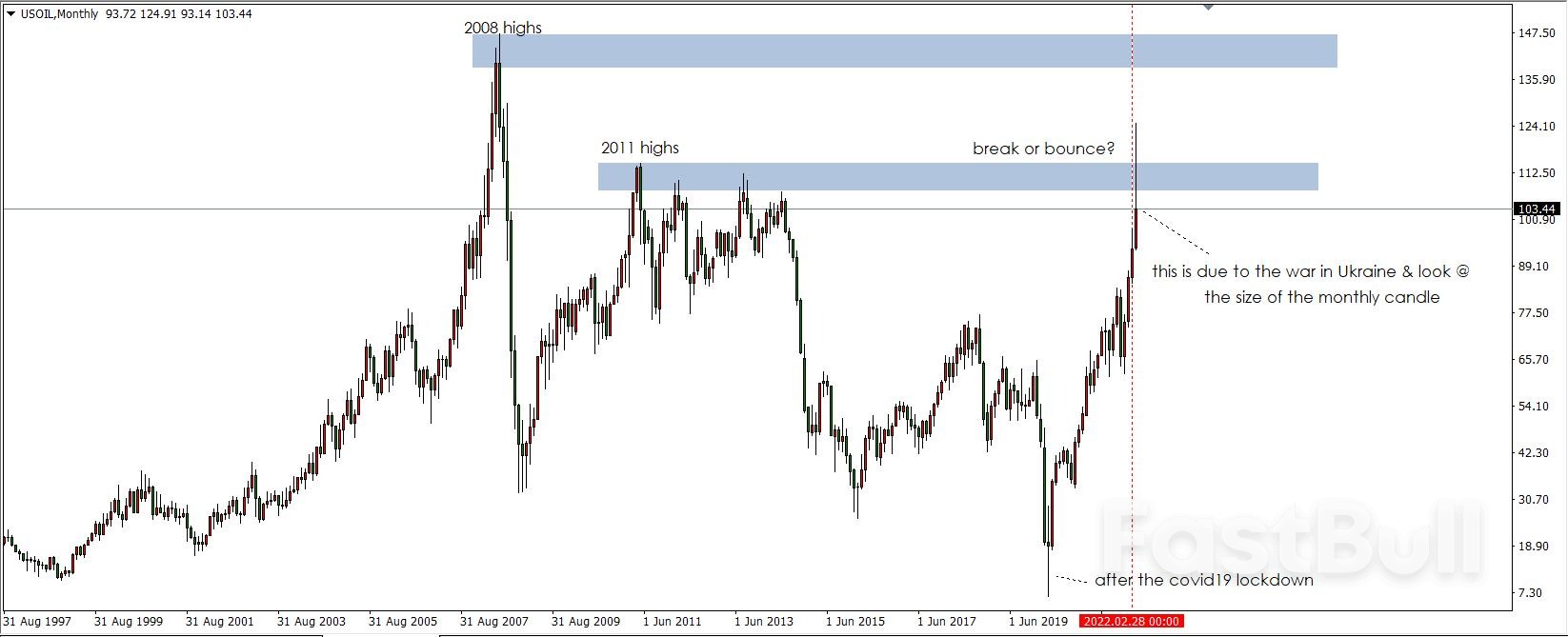
          Ever since the war started, we witnessed the drop in value of the Russian Ruble while the Crude Oil appreciated heavily, only to spike out of the highs from year 2011 (reaching $125 per barrel highs) and now sitting below the $112 per barrel Supply zone.
          On the economic calendar for today, it's pretty light on data but ensure to use visible stop loss and proper risk management as there's still a lot of uncertainty in the world and anything can happen at any moment.
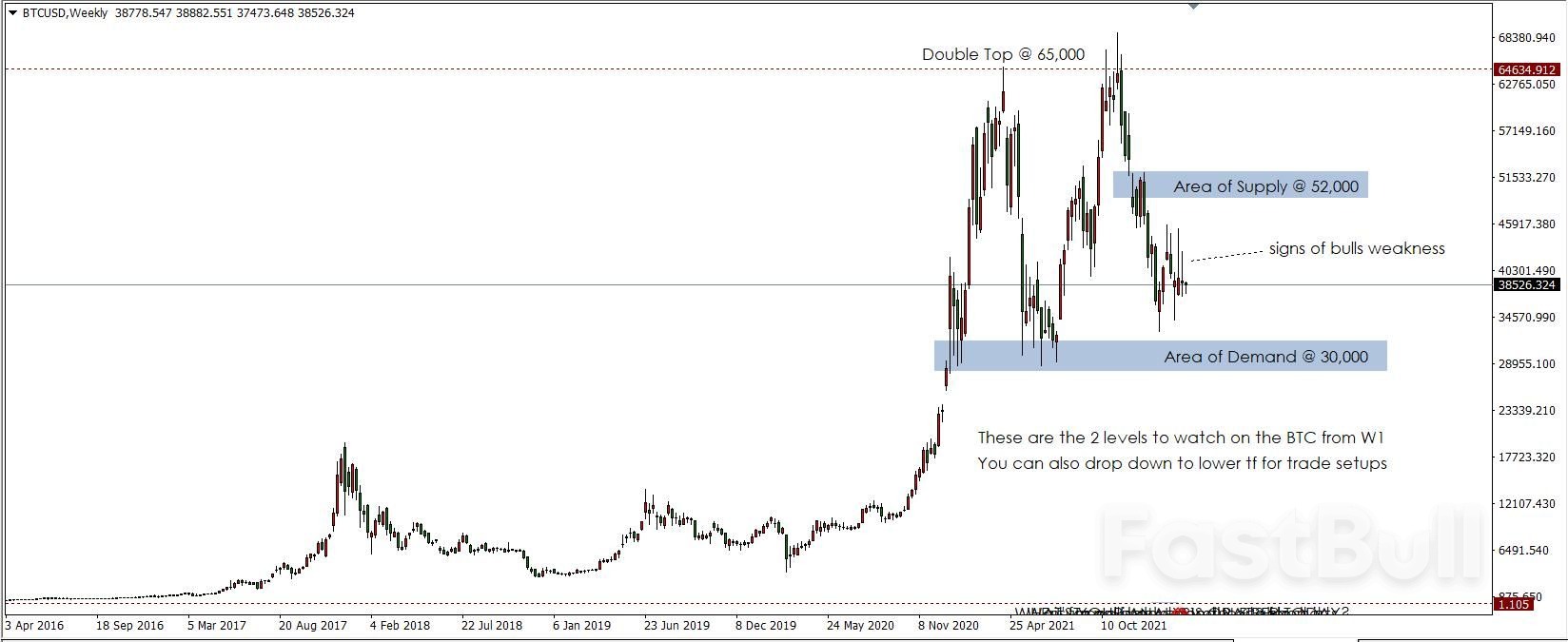
          Bulls weakness on the father of all cryptos, Bitcoin, is showing bearish bias on the weekly time frame and 30k is still very much on the cards. Checkout the rejection candles on the weekly as it struggles to stay above 45k.
          We were looking for a pullback on the Fiber (eurusd) to 1.1115 for possible shorts and we got it, now it should continue it's downward movement at least to test the lows of this year (1.080) before a break or bounce from the demand zone.
          Anyone paying attention to the dollar yen as it seems to have seen a ghost of late and surging higher & higher? This is one the counter-trend traders would love to short and fade strategically as well.
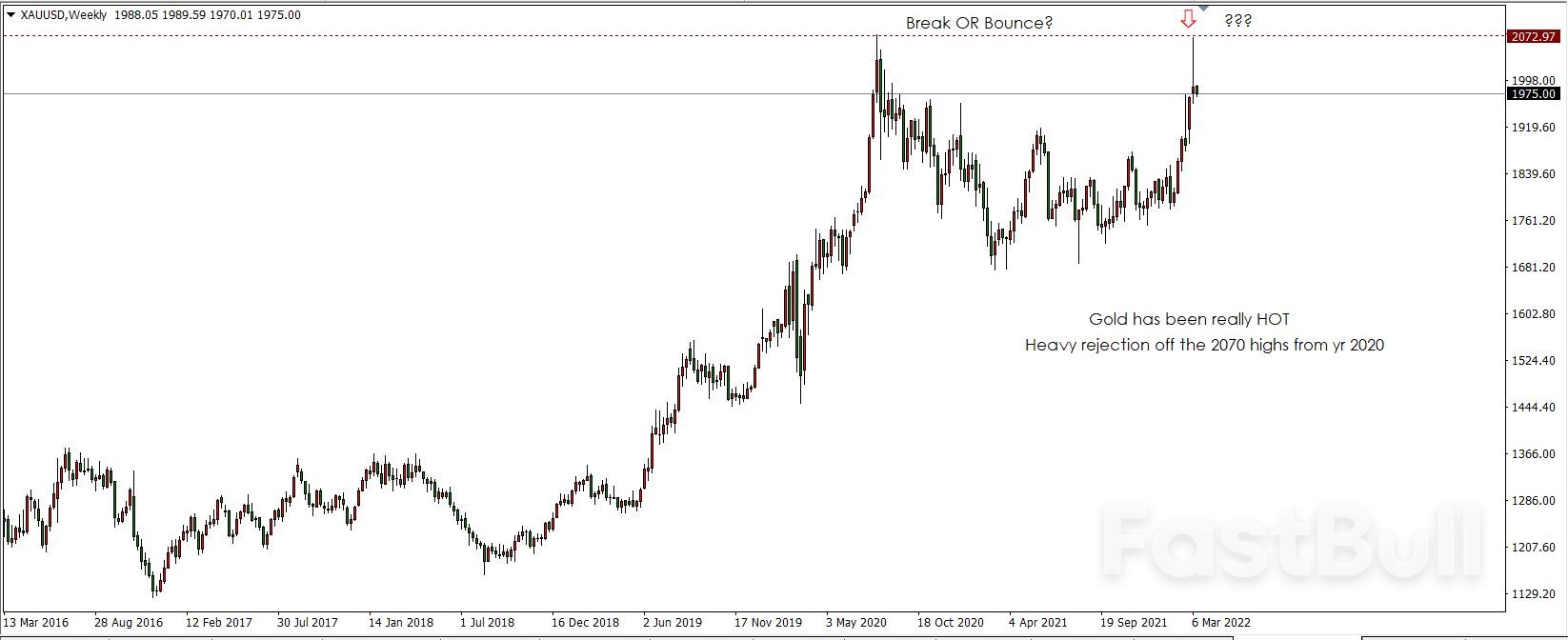
          Gold got heavily rejected off the yr 2020 highs at 2070 and we have a weekly Pinbar/Hammer candlestick pattern, it’s not in the best area/position & would love for another push higher for better entry on shorts.
          Trade Safely
          What's Happening in the Forex Market?_1
          What's Happening in the Forex Market?_2What's Happening in the Forex Market?_3
          Risk Warnings and Disclaimers
          You understand and acknowledge that there is a high degree of risk involved in trading. Following any strategies or investment methods may lead to potential losses. The content on the site is provided by our contributors and analysts for information purposes only. You are solely responsible for determining whether any trading assets, securities, strategy, or any other product is suitable for investing based on your own investment objectives and financial situation.
          Comments
          Add to Favorites
          Share

          How to Invest in Vietnam's Edtech Industry

          Thomas
          Vietnam's education technology (edtech) market has shown strong growth in part due to the pandemic, which pushed online learning as well as the consumer's appetite for additional learning.
          Vietnam has a population of 98 million, of which around 70 percent are under 35 years of age. Currently, it has about 17.5 million students at primary and secondary education levels, with approximately 1.7 million students enrolled in universities.

          Edtech market overview: A primer

          Edtech is the combination of education and technology using technological tools to facilitate education. It uses IT tools to enhance the individual learning experience.
          The Vietnamese edtech market is estimated to exceed US$3 billion by 2023. According to Tracxn Technologies, there are about 260 edtech businesses in Vietnam, most are start-ups and business to consumer (B2C) businesses.
          Edtech startups are luring the interest of both local and foreign venture capital funds as they bring new business models to tap into the online student consumer market. Investment deals in edtech were estimated to reach US$45 million in 2020. South Korea, the US, and Singapore are among the top investors in the market.
          In Vietnam, edtech companies focus on three main areas such as digital content, learning management systems (LMS), and integrating advanced technologies such as augmented reality (AR), virtual reality (VR), and artificial intelligence (AI).
          The digital content market is crowded with service providers offering various products, such as English language subjects and game-based learning content for early childhood education, test preparation, self-study options, e-books, and tutoring service searches for general education. A notable foreign player in this segment is Snapask, a Hong Kong-based startup which entered Vietnam in 2020 and provides a tutoring app for students in education.
          There are also several English teaching products for students and adults, such as Elsa or Duolingo. Some local edtech companies have also attempted to diversify their product content to other skill development areas such as Mathematics.
          This aligns well with the emerging desire of Vietnamese parents for their children to develop STEM skills. CoderSchool, a startup providing online training in programming, has recently announced that it has raised US$2.6 million in a Pre-Series A funding round led by Monk's Hill Ventures.
          The edtech market for digital content in Vietnam has also attracted foreign edtech groups in the growing trend of utilizing digital content by local schools. They have managed to access the market through their local sales agents which have strong relationships with education authorities.
          Some applications widely used in Vietnam include Quiver 3D Coloring in early childhood education and Merge Cube, a digital platform that helps students learn science and STEM effectively with 3D objects and simulations. Private school operation EQuest Education Group and AI-powered Clevai secured investment from Singapore and the US.
          Apart from digital content provision, edtech businesses also provide LMS platforms ranging from school administration, teaching and learning innovation, to tutoring and assessment services, and so on. Notable companies providing this solution in Vietnam are Wewiin, Ai Vietnam, and Topica Group.
          There are 237 universities in Vietnam of which 22 currently deliver distance learning programs, with e-learning as one of the delivery modes. Nevertheless, not all institutions have their own, in-house-developed platform for e-learning programs.
          Some universities that cannot afford their own LMS platform opt to partner with firms like Topica Group. The group owns a cyber university that delivers bachelor programs using Topica's platform, with technical and academic support provided for learners.
          Local start-up and domestic tech companies also offer solutions incorporating AR/VR or AI technologies. FPT, a top provider of IT services in Vietnam, has developed an app using AI to deliver a learning experience tailored to each student's strengths and weaknesses.
          Geniebook from Singapore offers a suite of online learning solutions for primary to secondary school students that includes signature AI-personalized worksheets and live classes. Meanwhile, there are also some foreign providers integrating AR/VR technologies such as CO-WELL Asia (Japan) and Hiverlab (Singapore).

          Opportunities for foreign investors

          Vietnam has significant potential for edtech market development. Key growth drivers include a high rate of internet users at 70 percent of the country's population and a tech-savvy community, accompanied by the rising demand for multimedia content, as well as learning options that are low-cost and time-efficient.
          In addition, the education sector plays an important part in the digital transformation agenda of the Vietnamese government; therefore it is strongly supported by all key stakeholder groups, including policymakers, educational managers, lecturers, teachers, and students.
          Accelerated by the pandemic, several edtech companies have been experiencing strong growth, but there is no dominant player in the local market. Experts say that Vietnamese edtech firms still lack breakthrough technologies to grow stronger. This presents attractive opportunities for investors to look at.
          Higher education and vocational training
          Blended learning has gained popularity and has become an effective tool in Vietnam as the country adapts to the new normal of living with the pandemic. By combining traditional face-to-face teaching and e-learning with computer-mediated support, this hybrid method is expected to achieve higher efficiency.
          As many Vietnamese educators shift towards this education method, blended learning offers opportunities for Vietnamese businesses to partner with foreign investors; local partners can play the role of a recruiting hub while assessing the market.
          An initiative collaboration in this segment has been the undergraduate degree in ICT jointly delivered by Swinburne University of Technology (Australia) and FPT University (Vietnam). The blended learning experience was based on the courseware and the ICT system by Swinburne, while FPT University would provide mentors and other learning support, as well as marketing the courses locally and administering admissions and enrollment.
          Regarding vocational education and training (VET), partnerships with vocational colleges which have been recognized as high-quality institutions, and have a long-term vision on skill development, may provide an entry point for exploring new collaboration for online VET delivery. Foreign businesses and Vietnamese partners could explore collaboration in the delivery of micro-credentials or mini-qualifications recognized by industries, such as tourism and hospitality, IT, design, and communication.
          Early childhood education
          The early childhood education sector is a niche market in Vietnam, which offers potential business opportunities in private kindergartens responding to the Government's strategic sector development plan.
          Opportunities for edtech businesses in this segment include designing digital content for children to learn a foreign language as well as fundamental soft skills, teacher training solutions provided on digital platforms, or sharing experience and professional expertise in curriculum development, quality assurance, and managing digital agenda implementation at an institutional level.
          Recently, Japanese Gakken Holdings has partnered with Vietnamese edtech company KiddiHub Education Technology, an information provider for kindergartens. Gakken is planning to use KiddiHub's established online presence to promote non-cognitive learning that focuses on critical thinking skills.
          General education
          The Vietnamese government has undertaken significant education system reforms, seeking to bring Vietnam's quality of human resources in education to international standards. General education has undergone tremendous reform in all areas recently. In particular, the country has a new general education program associated with basic changes in student assessment methods, teaching methods and materials, and changes in criteria for teacher assessment.
          For instance, a new competency-based curriculum has replaced conventional delivery based on a single set of textbooks and attempted to integrate STEM/STEAM into the curriculum has put a strong emphasis on innovative delivery modes and methods.
          In this segment, potential business opportunities for edtech partners include digital content, particularly in STEM/STEAM subjects, e-textbook, teacher training, and assessment products, particularly for English language training.
          E-learning in corporate training
          Vietnam's e-learning market also offers the potential for online training products for business customers. There is a rising demand for the use of LMS to integrate conventional in-house corporate training processes that effectively deliver to large numbers of staff in Vietnam. Examples include state-owned Vietnam Electricity (EVN) and Vietcombank which have set up their own e-learning centers in order to achieve effective human resource development. Potential industries are banking, tourism, and hospitality.

          Market entry strategies in edtech

          To capitalize on the full potential of the edtech market in Vietnam, foreign edtech providers need to navigate existing challenges, such as the regulatory landscape for setting up and operating an edtech entity in Vietnam.
          Edtech remains a vague area under the Vietnamese legal framework since it has not been explicitly specified in legal documents. Investors who seek to undertake edtech related business activities should review the requirements on a case-by-case basis.
          Relevant laws governing foreign investment in edtech include the Law on Investment, the Law on Education, Commercial Law, as well as a number of decrees and circulars regulating specific activities.
          These include Decree 86/2018/ND-CP on foreign cooperation and investment in the educational sector, Circular 21/2018/TT-BGDDT on organization and operation of foreign language and IT centers, and Decree 09/2018/ND-CP on the sale of goods by foreign investors and foreign-invested business entities in Vietnam.
          The Vietnamese government has recognized certain inconsistencies in the legal framework regulating edtech and is thus is working on a draft circular that provides unified guidance on E-learning activities.
          For now, investors are required to satisfy various investment conditions and obtain relevant sub-licenses to operate in Vietnam, depending on specific edtech activities and business models. In general, foreign investors in edtech must register their business lines to cover some or all of the following:
          • Educational activities;
          • Technological activities;
          • Trading activities.
          For educational activities, investors are allowed to form 100 percent foreign education entities such as short-term training institutions, pre-schools, compulsory education institutions, higher educational institutions, and branch campuses of foreign-invested higher education institutions, with conditions on minimum capital applied.
          Registering for trading activities with the Ministry of Industry and Trade (MoIT) is required if companies distribute online courses with curriculum or programs developed by another party or provide an e-commerce platform for education.
          While education and trading are conditional for foreign investors, ICT is one of the encouraged special investment sectors by the Vietnamese government. Upon registration for IT and computer programming activities, edtech companies are entitled to a corporate income tax exemption for up to 4 years, followed by a 50 percent tax reduction for up to 9 years.
          Subsequently, a preferential CIT rate of is applied (compared to the traditional 20 percent for a period of 15 years). Further, there is also a privileged policy for workers employed in the IT sector, including a 50 percent reduction in personal income tax.
          Foreign edtech businesses can also consider entering the Vietnamese market by collaborating with a local partner to avoid complex setup procedures. Potential partners for foreign investors can be an education entity, a technology firm, or a local sales agent. Working with a local partner can be beneficial as they will help enhance market access and strengthen foreign brands' footprint in Vietnam via their local experience and wide network with domestic stakeholders.

          Source: Vietnam Briefing

          Risk Warnings and Disclaimers
          You understand and acknowledge that there is a high degree of risk involved in trading. Following any strategies or investment methods may lead to potential losses. The content on the site is provided by our contributors and analysts for information purposes only. You are solely responsible for determining whether any trading assets, securities, strategy, or any other product is suitable for investing based on your own investment objectives and financial situation.
          Comments
          Add to Favorites
          Share

          Americans to Feel Inflation Pinch Amid Russian Oil Ban

          Damon
          Gasoline prices are now surging to record highs in the US, prompting American police to warn motorists to guard against rising cases of gas theft - thieves who drill a hole in a fuel tank and drain all the gas with a siphon hose. How precious is the fuel? It used to cost $40 to fill a tank, but now the bill has shot up to more than $100.
          To make things worse, consumer prices of nearly all commodities and services in the US have kept rising since President Biden was elected to the White House early last year. And, American households are unlikely to see a relief any time soon.
          Hyperinflation seems set to plague the US throughout 2022 and beyond, as the Biden administration bungles economic management by flooding it with endless credit lines and fiscal budget deficits since entering office. Last year, the administration pushed Congress to pass a $1.9 trillion fiscal stimulus bill which propelled inflation, and just a few days ago, another $1.5 trillion spending bill was approved by the US Senate, including $782 billion to fund American troops, of which a disproportionate chunk will end up in the pockets of the American military-industrial complex (MIC).
          The ongoing military conflict in Ukraine, and the US government's penchant for playing geopolitics and taking a zero-sum game approach to major rivals or adversaries like Russia, will keep the CPI levels elevated in the US for a foreseeable longer time.
          The swift and sweeping economic sanctions being placed on Russia by the US and its Western allies, and Moscow's countermeasures will almost certain stretch the US supply chain to near breaking point, driving the prices of fuel, mineral resources, food and other items even much higher. And, Trump's reckless trade war with China is inherited by Biden for the sole purpose to slow down China's economic rise, though the tariffs levied on $360 billion imported Chinese goods have ended up manifesting as higher price tags at the US supermarkets.
          The majority of American families ought to be prepared for a harder life in the months, if not years ahead, as high prices eat into their buying power and erode livelihoods. The onus is on the Biden government to bring inflation down, but unfortunately, his economic team and the Federal Reserve are not up to the job.
          For a time, the US government officials have hidden their heads deep in the sand like a horde of ostriches, telling the American public that inflation was just "transitory" -- meaning temporary. Lately, when asked by reporters what he will do to address surging prices, Biden shrugged his shoulders, saying that Russia is the cause for the staggering oil price hike.
          It's laughable and silly to place the blame squarely on Russia.
          After the military conflict between Russia and Ukraine broke out in late February, the US and its allies have rushed to sanction Moscow, cutting its banks off from the SWIFT global financial settlement system, seizing Russia's assets overseas, and prodding Western businesses to abandon Russian market. Obviously, the US and its allies are aiming to suffocate the Russian economy into an immediate coma, because a severely wounded Russia will lose ability to compete with the US.
          However, in the eyes of many other nations and peoples on this globe, it is the US-led NATO that has kept expanding, enrolling numerous countries big or small in Europe and making consistent inroads toward Russia's doorstep, seriously threatening the national security of a sovereign nation. If Ukraine had renounced its intention to join the NATO, or the world's largest military alliance had made a written pledge not to admit Ukraine, the Ukraine conflict could have been avoided.
          To pummel Moscow, last week President Biden even ordered to ban imported oil, natural gas and other energy products from Russia - a very unreasonable move as the US is already suffering from an inflation of energy prices. For the purpose of stifling or destroying Russian economy, the US government eagerly wanted to wrench Moscow's throat harder, even at its own peril. In a worst-case scenario, crude oil prices may surpass $200 a barrel in 2022.
          And, another drama has taken the stage before global eyes. As Russia used to export 4-5 million barrels a day, the Biden administration is seen begging America's old foes like Venezuela and Iran to increase crude supplies and make up for the sanction induced shortfall. To date, the White House refuses to disclose how much oil it is seeking or describe any progress of talks with other oil-producing countries.
          The current round of ferocious inflation covers across-the-board commodities and services, which could be worsened by the unpredictable course of the coronavirus pandemic, the conflict in Ukraine, and the US-led economic warfare with Russia.
          History has told us that in hard times, tens of millions of small and medium-size businesses will suffer from supply chain disruption and forbiddingly high costs, and, ordinary wage-earners, pensioners, and their children, will have to bear the brunt of consequences.

          Source: Global Times

          Risk Warnings and Disclaimers
          You understand and acknowledge that there is a high degree of risk involved in trading. Following any strategies or investment methods may lead to potential losses. The content on the site is provided by our contributors and analysts for information purposes only. You are solely responsible for determining whether any trading assets, securities, strategy, or any other product is suitable for investing based on your own investment objectives and financial situation.
          Comments
          Add to Favorites
          Share

          Ukraine War Risks Setting Back Recovery in South-East Asia's $500m Tourism Industry

          Thomas

          Russia-Ukraine Conflict

          DENPASAR (BALI) – War. Spiralling airfares. Cancelled flights.
          So far, the recovery that South-east Asia's tourism industry was hoping for in 2022 is shaping up to be anything but.
          For two years, hotels and resorts here have bided their time, hoping holidaymakers from Asia, Europe and Australia would come back to soak up the sun, rent a villa and breathe new life into an industry that at its peak in 2019 was valued at US$380 billion (S$518 billion).
          Tourism juggernauts like Thailand and Indonesia's resort island of Bali, which together took in 46 million overseas arrivals in 2019, are easing quarantine restrictions and reopening air links with key markets like Singapore and Australia.
          But the war in Ukraine and sanctions against Russian banks threaten to hamstring fast-growing markets just as surging crude oil prices sap spending in more established ones.
          “Unbelievable,” said Mr Dirk De Cuyper, chief executive officer of S Hotels and Resorts.
          Before the war, his company, which operates 38 hotels in Thailand and Britain, as well as in Fiji, Mauritius and the Maldives, had expected occupancy to recover to levels not far from where they were before the pandemic.
          Last year, S Hotels and Resorts splashed out millions on upgrades in the Maldives and Thailand, including 72 million baht (S$3 million) on ocean view villas complete with private pools that start at 17,000 baht a night, aimed at travellers with deeper pockets.
          “Surely, this will impact in the short term Russian travel and the cost of goods and utilities,” said Mr De Cuyper.
          At nearly 24,000 arrivals in January, Russian tourists were by far Thailand's biggest cohort of arrivals, and among the top 10 of Thailand's neighbours, including Indonesia and Vietnam.
          That is beginning to change.
          The number of Russian arrivals into Phuket's airport has plunged so far this month by three-quarters, Mr Bhummikitti Raktaengam, president of the Phuket Tourist Association, was quoted as saying in local media last Thursday (March 10).
          Additionally, around 3,000 of the country's nationals are thought to be stranded, unable to get home after direct flights to Moscow, as well as to Russia's Far East, were suspended, according to the report.
          Many Russian holidaymakers say they cannot access savings at home after many of their country's biggest banks were booted from the Swift international payments system and credit card companies Visa and Mastercard suspended operations there.
          To be sure, for now, the full impact of the sudden slump in Russian traffic may be muted.
          With the monsoon approaching parts of Asia north of the Equator, European traffic, including arrivals from Russia, tends to taper off this time of year.
          Mr Markland Blaiklock, deputy chief executive of Bangkok-based Centara Hotels and Resorts, said the company is on track to double revenues by 2026 as it opens a slew of new hotels in Thailand, as well as in the Middle East and the Maldives, despite the crisis.
          “We are hoping the conflict will be resolved quickly and impacts will mostly be confined to 2022,” Mr Blaiklock told The Straits Times.
          But tourism operators face other headaches too.
          Would-be travellers from Australia were told last week by their national flag carrier, Qantas, that the 60 per cent surge in crude oil prices since the beginning of the year would translate into a 7 per cent average hike in airfares.
          The carrier's airfares will rise an additional percentage point for every US$4 gain in the price of crude oil. Last week, West Texas Intermediate crude oil futures reached an eight-year high of US$123 a barrel.
          Still, it is the sudden loss of the promising Russian market that has come as a shock for many tourism players this year.
          The number of Russian visitors to Vietnam doubled to nearly 650,000 during the four years to 2019, each spending on average US$1,900 per visit – nearly 80 per cent more than the average foreign visitor, according to government data cited by local media.
          Mr Seif Hamdy of the Intercontinental Danang Sun Resort said that after a US$40 million overhaul of some of his property's restaurants, lobbies and villas, wooing Russian tourists had been a big goal this year.
          A charter flight announced in late 2019 between Danang and as many as four Russian cities, including Moscow, has yet to go into service after the plans were shelved the following March, owing to the onset of the Covid-19 pandemic.
          “The Russian market was supposed to be our new target market this year,” Mr Hamdy said. “We're waiting on news of the flight. Without airlift, that's just not possible.”

          Source: The Straits Times

          Risk Warnings and Disclaimers
          You understand and acknowledge that there is a high degree of risk involved in trading. Following any strategies or investment methods may lead to potential losses. The content on the site is provided by our contributors and analysts for information purposes only. You are solely responsible for determining whether any trading assets, securities, strategy, or any other product is suitable for investing based on your own investment objectives and financial situation.
          Comments
          Add to Favorites
          Share

          Canada Adds 337K Jobs in February, Unemployment Drops Below Pre-Pandemic Levels

          Damon
          Canada's labour market showed signs last month of finally shaking off the shock COVID-19 delivered two years ago, with the share of workers with a job and the unemployment rate besting levels seen just prior to the pandemic.
          A gain of 337,000 jobs in February more than offset the loss of 200,000 jobs in January and dropped the unemployment rate to 5.5 per cent, falling below the 5.7 per cent level where it was at in February 2020.
          Statistics Canada said the unemployment rate would have been 7.4 per cent last month had it included in calculations people who wanted a job but did not look for one.
          The majority of the decline in the ranks of Canada's unemployed came from people called back to work in February after a temporary layoff one month earlier as provinces tightened restrictions to slow the spread of the Omicron variant.
          As restrictions eased, eight provinces saw job increases, although Alberta and New Brunswick stayed flat. Gains were notable in sectors hardest hit by public health restrictions, including accommodation and food services, which added 114,000 jobs.
          The proportion of the working-age population with a job also rose in February to 61.8 per cent, marking the first time that rate returned to its pre-pandemic level. The employment and participation rates for core-age working women reached their highest levels on record.
          “From an overall labour markets perspective, it's more than healed from the losses that have occurred during the course of the pandemic,” RBC economist Claire Fan said.
          Underneath the top-level figures were indicators of scars yet to heal. The Canadian Labour Congress noted that accommodation and food services was 17 per cent below pre-pandemic employment levels.
          Wages, while rising as businesses jostle for workers, also still lag inflation. Congress president Bea Bruske said hidden in the rosy job numbers were hundreds of thousands of workers being left behind.
          The number of Canadians who have been out of work for six months or more remains 32,000 higher than in February 2020, although their ranks have dwindled for four straight months to 212,000.
          Kaylie Tiessen, an economist with Unifor, noted the proportion of part-time workers who wanted full-time jobs had risen anew after dropping earlier in the pandemic. While the employment rate for racialized worker returned to pre-pandemic levels, Tiessen said it remained higher than rates for non-racialized workers.
          “We've gotten back to a pre-pandemic level and this is something to celebrate, but is it good enough? If we want an inclusive economy, we have to put in the effort,” she said.
          It is one of several challenges facing policy-makers in the coming months.
          Royce Mendes, head of macro strategy at Desjardins, said with low unemployment and record-high job vacancies across the country, the labour market may have reached capacity, or full employment.
          The pool of available workers may also be shrinking. Fan pointed to the participation rate for those over 55 being below pre-pandemic levels, suggesting the pandemic may have accelerated retirement plans for some older workers.
          While the number of employed youth is back to pre-pandemic levels, where they work has shifted from accommodation and food services to professional and technical services, as well as health care.
          Statistics Canada said affordability concerns and workers' desire for more flexible work could influence companies' ability to attract and retain employees through return-to-office plans.
          “Workers feel like they have more leverage these days with the tight labour market, it could be they're realizing that their needs for what they're looking for in their jobs have changed drastically,” Fan said. “More workers might be stepping back and re-evaluating, ‘What exactly do I want?'”
          Leah Nord, senior director of workforce strategies for the Canadian Chamber of Commerce, warned the situation is going to make it difficult to fill the nearly one million job vacancies across the country. She cited the need for a strategy that includes immigration and skills training.
          Asked about labour shortages, federal Employment Minister Carla Qualtrough said both issues were part of federal efforts, adding so too was tapping into untapped labour pools like Canadians with disabilities and Indigenous people.

          Source:Global NEWS

          Risk Warnings and Disclaimers
          You understand and acknowledge that there is a high degree of risk involved in trading. Following any strategies or investment methods may lead to potential losses. The content on the site is provided by our contributors and analysts for information purposes only. You are solely responsible for determining whether any trading assets, securities, strategy, or any other product is suitable for investing based on your own investment objectives and financial situation.
          Comments
          Add to Favorites
          Share

          White House Faces Oil Standoff with Saudi Arabia And UAE As Prices Soar

          Devin
          Joe Biden's hardline stance on Russia has won him widespread plaudits, but with the most serious oil shock in decades now a reality, the US president's attempt to cushion the blowback continues to meet resistance from the two allies he needs most.
          Saudi Arabia's de facto leader, Mohammed bin Salman, and his counterpart in the United Arab Emirates, Mohammed bin Zayed, are yet to agree to a phone call with the west's most powerful man – a scenario all but unthinkable during previous administrations.
          Biden's immediate priority is for both countries to help exert maximum economic pressure on Russia by cranking up their oil output. Each capital is a major supplier of oil, with excess capacity, which would soften the effect on US consumers through fuel prices before midterm elections in November that threaten Democratic control of Congress.
          With relations between the Middle East oil powers and Washington at their lowest ebb in modern times, though, a reckoning is due that may realign the regional order on terms that favour Riyadh and Abu Dhabi. Both leaders have made it clear that they will settle for nothing less, and are ready to extract their price.
          As if to show the Biden administration what it could do, the UAE ambassador to Washington, Yousef al-Otaiba, last Wednesday said it favoured production increases “and will be encouraging Opec to consider higher production levels”, leading oil prices to fall by 13% the next day. But no action to increase supply followed and by the week's end the price per barrel was back up to almost $130 (£100), an uncomfortably high level for Biden to take to the midterms.
          However, the standoff involves far more than oil. In Riyadh, Prince Mohammed feels snubbed by Biden's refusal to engage with him ever since he took office. The murder of the Saudi dissident Jamal Khashoggi by the crown prince's security aides, the war on Yemen, the jailing of rights activists and the boycott of Qatar have made him a pariah to the administration.
          Disputes with Abu Dhabi are nearly as stark. The US has been particularly taken aback by UAE's repeated abstentions in the UN security council, which have been seen by western diplomats in New York as a quid pro quo for Russian support of some of the anti-Houthi positions it wanted the council to take over the war in Yemen.
          Saudi Arabia and the UAE have been incensed by the Biden administration removing the Iran-backed Houthis from the global terror list as they continue a painstaking series of negotiations with Iran to restart the Obama-era nuclear deal shredded by Donald Trump.
          Beyond that, though, there is a strong feeling in both capitals that Biden has approached the region with a deeply critical view of countries that had long been security allies, and lenient on Iran, which remains a foe.
          Having attempted last week to recruit Venezuela to the cause of isolating Russia, the White House views efforts at repair work on the relationship with Saudi Arabia and the UAE as an acceptable price to pay.
          The administration in February sent Brett McGurk, the White House coordinator for Middle East policy, and Amos Hochstein, the state department's special energy envoy, to Riyadh for a meeting with the crown prince. On the eve of the invasion of Ukraine, the Treasury announced sanctions on an alleged Houthi financing network.
          Sir John Jenkins, a former British ambassador to Riyadh and a senior fellow at the UK thinktank Policy Exchange, said ties that had been growing between Riyadh and Moscow, particularly since Biden sidelined Prince Mohammed, would probably need to be recalibrated if a reset was to take place.
          “I think it's very complicated,” he said. “I wouldn't make a one-way bet on Putin myself. But that's how the Saudi position in particular will look to many in DC. That will just piss people off. And tempt them in turn to bet on Iran instead. You have to deal with [Prince Mohammed]. But if he demands a complete climbdown from Biden, I don't think he'll get it.
          “There has to be some way of squaring this circle. A renewed US promise to defend KSA [Saudi Arabia] and the UAE from Iran is one way. Redesignation of the Houthis and a renewed commitment to settling Yemen in a way that would suit Riyadh and Abu Dhabi is another. But I can't see Biden saying he's simply going to forget Khashoggi.
          “I personally don't think Russia matters that much to KSA. China's far more important. Beijing wants to avoid a collapse of global trade – or a prolonged western recession. And there are signs Beijing is trying to position itself appropriately. The risk then is that a hard line from Riyadh will just backfire.”
          Robin Mills, the CEO of the UAE-based consultancy Qamar Energy, said increasing oil supply, and therefore reducing prices at the bowser, was a relatively straightforward technical process, but carried political and economic risk in dealings with the global oil body Opec, of which Riyadh and Abu Dhabi are members.
          “They could ramp up supply within one month and reach full capacity within 90 days,” he said. “Opening chokes on wells, restarting wells entirely, perhaps restarting gathering and production stations.
          “Everyone has always cheated on Opec agreements when it suited them. Can you do it quickly? Not tomorrow, certainly. But unless something's gone seriously wrong, KSA should be able to make a three-month difference. That in itself would help – to a degree – in calming oil markets.”

          Source: The Guardian.

          Risk Warnings and Disclaimers
          You understand and acknowledge that there is a high degree of risk involved in trading. Following any strategies or investment methods may lead to potential losses. The content on the site is provided by our contributors and analysts for information purposes only. You are solely responsible for determining whether any trading assets, securities, strategy, or any other product is suitable for investing based on your own investment objectives and financial situation.
          Comments
          Add to Favorites
          Share
          FastBull
          Copyright © 2025 FastBull Ltd

          728 RM B 7/F GEE LOK IND BLDG NO 34 HUNG TO RD KWUN TONG KLN HONG KONG

          TelegramInstagramTwitterfacebooklinkedin
          App Store Google Play Google Play
          Products
          Charts

          Chats

          Q&A with Experts
          Screeners
          Economic Calendar
          Data
          Tools
          Membership
          Features
          Function
          Markets
          Copy Trading
          Latest Signals
          Contests
          News
          Analysis
          24/7
          Columns
          Education
          Company
          Careers
          About Us
          Contact Us
          Advertising
          Help Center
          Feedback
          User Agreement
          Privacy Policy
          Business

          White Label

          Data API

          Web Plug-ins

          Poster Maker

          Affiliate Program

          Risk Disclosure

          The risk of loss in trading financial instruments such as stocks, FX, commodities, futures, bonds, ETFs and crypto can be substantial. You may sustain a total loss of the funds that you deposit with your broker. Therefore, you should carefully consider whether such trading is suitable for you in light of your circumstances and financial resources.

          No decision to invest should be made without thoroughly conducting due diligence by yourself or consulting with your financial advisors. Our web content might not suit you since we don't know your financial conditions and investment needs. Our financial information might have latency or contain inaccuracy, so you should be fully responsible for any of your trading and investment decisions. The company will not be responsible for your capital loss.

          Without getting permission from the website, you are not allowed to copy the website's graphics, texts, or trademarks. Intellectual property rights in the content or data incorporated into this website belong to its providers and exchange merchants.

          Not Logged In

          Log in to access more features

          FastBull Membership

          Not yet

          Purchase

          Become a signal provider
          Help Center
          Customer Service
          Dark Mode
          Price Up/Down Colors

          Log In

          Sign Up

          Position
          Layout
          Fullscreen
          Default to Chart
          The chart page opens by default when you visit fastbull.com